How to release tension stored in the body
Tight shoulders, a clenched jaw, hips that never fully soften. Tension is not only in the mind; the body learns to hold it, sometimes for years. The good news is that the body can also learn to let it go.
Most of us notice our tension only when it hurts: a stiff neck in the morning, a headache after a long day, a lower back that complains when we stand up. But the holding started long before the pain. The body braces a little, many times a day, until bracing becomes its normal state.
In short
- Tension is held in muscles, breath and connective tissue (fascia), often outside our awareness.
- It builds through repeated stress responses, posture and emotions that were not expressed.
- Release comes from giving the nervous system safety: breath, gentle movement, shaking, touch and attention.
- Short daily practice changes more than an occasional long session.
Why the body holds tension
Tension is a protective response. When the nervous system senses pressure or danger, it prepares muscles for action. In short bursts, this is healthy. The problem appears when the response is triggered again and again, by deadlines, conflict, screens, worry, or emotions we chose not to show, and the body never receives the signal that it is safe to stand down.
Over time the body adapts. The shoulders stay slightly lifted. The jaw stays a little clenched. The breath stays high in the chest. These patterns feel normal precisely because they are constant.
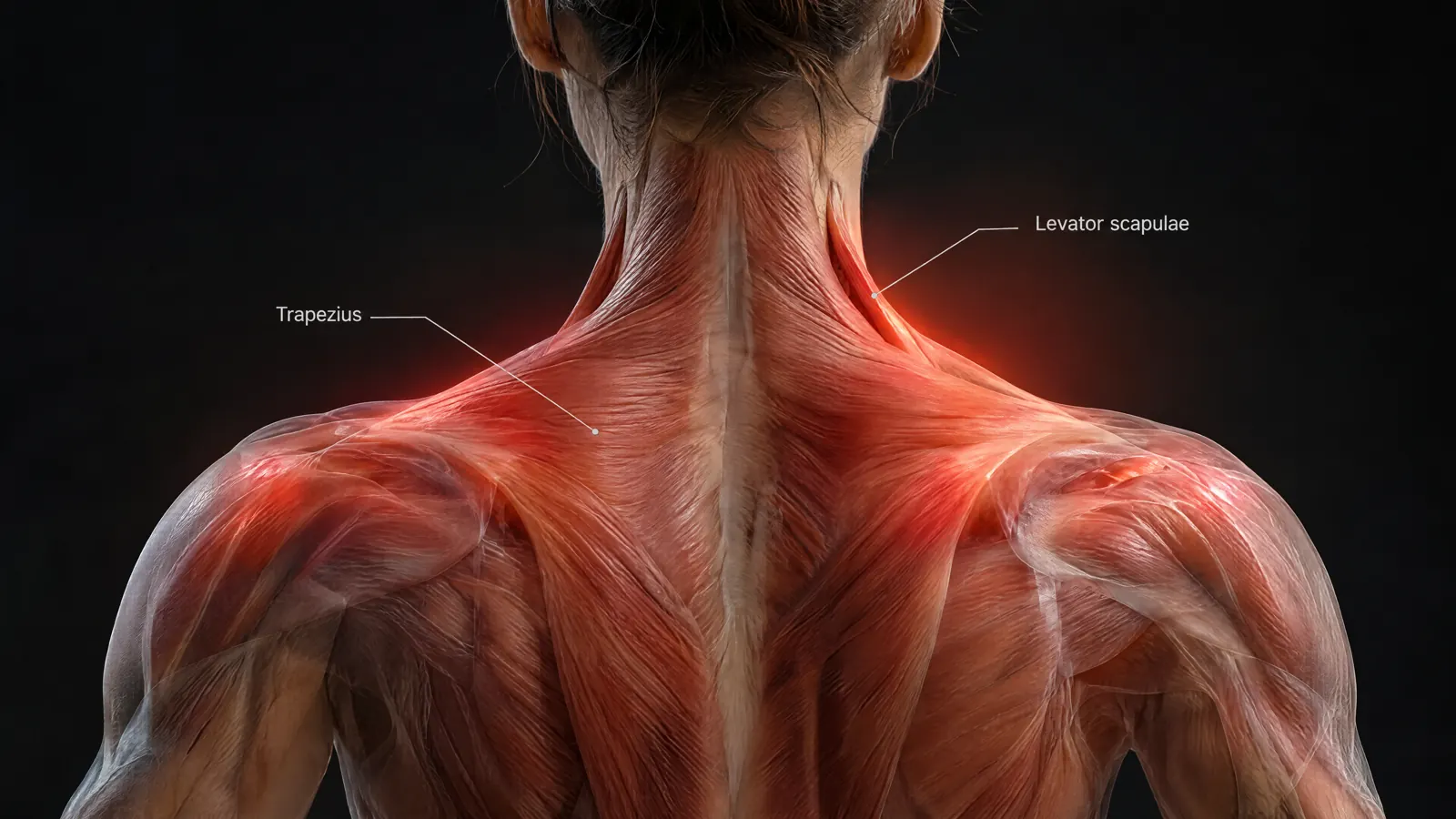
Where tension hides
- Jaw and face: clenching, grinding, a fixed expression.
- Neck and shoulders: lifted shoulders, a forward head, stiffness when turning.
- Diaphragm and belly: shallow breathing, a belly that is always held in.
- Lower back and hips: deep hip flexors like the psoas, which connect the spine to the legs and react strongly to stress.
- Hands and feet: gripping, curled toes, cold extremities.
Tension is not only in the muscles: fascia
Fascia is the web of connective tissue that wraps every muscle, organ and nerve. For a long time it was seen as passive packaging. Research led by Robert Schleip has shown that fascia contains contractile cells (myofibroblasts) that can slowly increase its tension, and that its stiffness and glide change with movement, hydration and long periods of stillness.

This helps explain why a stiff shoulder can be connected to the opposite hip, or why release sometimes travels through the whole body in a wave. It also explains why slow, varied movement and touch are so effective: fascia responds to time, warmth and gentle, sustained input.
Six ways to release stored tension
1. Lengthen the exhale
Slow breathing with a longer out-breath shifts the nervous system towards rest. A large review of 223 studies found that voluntary slow breathing increases vagally mediated heart rate variability, a marker of the body's ability to calm down.
2. Shake it out
Stand and gently shake your hands, arms, legs and whole body for one or two minutes. Shaking is one of the body's natural ways to discharge activation. Read more about neurogenic tremors.
3. Tense, then let go
Progressive muscle relaxation is one of the best studied relaxation techniques: tense a muscle group for five seconds, then release it completely and feel the difference for twenty seconds.
4. Move slowly, in all directions
Slow, curious movement of the spine, hips and shoulders hydrates fascia and shows the nervous system that there is space. Go slower than you think you need to.
5. Use touch
Your own hand resting on your belly, chest or the back of your neck is a powerful signal of safety. Skilled touch on precise points can go even deeper, which is the foundation of Sensory Energetics.
6. Notice without fixing
Many people try to force themselves to relax. Paradoxically, simply noticing where you hold, with curiosity, is often what allows it to soften.
A three-place release
- Sit or stand comfortably. Notice your jaw, shoulders and belly. Which feels tightest?
- Gently exaggerate the tension in that place for five seconds.
- Let go completely on a long exhale through the mouth, as if sighing.
- Repeat twice, then shake your hands loosely for thirty seconds.
- Notice the three places again. What changed?
How Sensory Energetics helps the body let go
Sensory Energetics (KSE®) is a neuro-somatic method that works with the nervous system, fascia and sensory awareness. Using precise touch on vital points, breath and movement, it invites the body to release holding patterns from the inside, often through natural tremors and waves of relaxation, rather than by stretching or forcing.
You can start at home with the Self-Ignition Programme, learn more about regulating your nervous system, or join a seminar in 2026.
Frequently asked questions
Where is tension usually stored in the body?
The most common places are the jaw, neck and shoulders, the upper back, the diaphragm and belly, the lower back and the hips, especially the deep hip flexors. Where it collects differs from person to person and often follows posture, habits and how we respond to stress.
Can emotions be stored in the body?
Emotions are not stored like objects, but emotional states come with physical patterns: holding the breath, bracing muscles, guarding the belly. When those patterns repeat, they can become habitual. Releasing the physical pattern often brings emotions to the surface, which is why people sometimes feel emotional during bodywork.
What is the fastest way to release tension?
For quick relief, lengthen your exhale, shake out your arms and legs for a minute, or tense a tight area for five seconds and then let go completely. For lasting change, a short daily practice works better than an occasional long session.
Can fascia hold tension?
Fascia, the connective tissue that wraps muscles and organs, contains cells that can contract, according to laboratory research. Its stiffness and glide also change with movement, hydration and inactivity. Slow movement, stretching and touch are good ways to keep it supple.
When should I see a professional?
If tension comes with pain that does not improve, numbness, weakness, headaches that change, or if stress is affecting your sleep and daily life, see a doctor or a qualified therapist. Body practices are a complement to professional care, not a replacement.
This article is for education and personal awareness. Sensory Energetics is not a medical or psychological treatment and does not replace professional care.

Dr. Daniel FlashFounder of Sensory Energetics (KSE®), Doctor of Natural Medicine and former martial arts World Champion. He has taught Kyusho and somatic energy work for more than 20 years, in 68+ countries. Read his story.
Let your body learn a new way to let go
Daily guided practices online, or three days in person with Dr. Daniel. Both teach you to feel where you hold, and to release it from the inside.